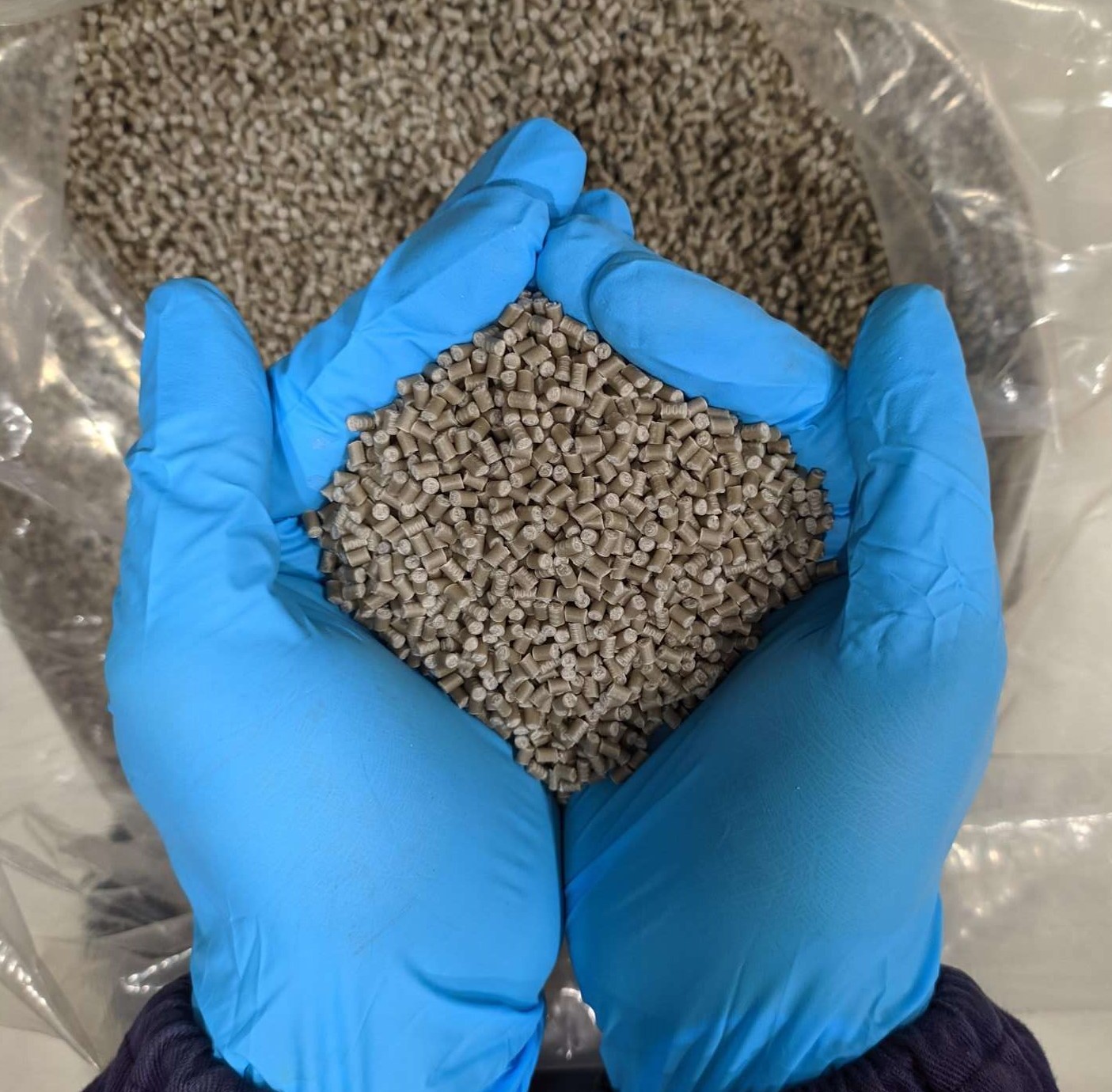
Injection Moulding Compounding (IMC) technology, which combines compounding and injection moulding in a single process, is an innovative approach particularly suited for processing thermally sensitive thermoplastics and/or those incorporating long fibres. This methodology, which combines compounding and moulding in a single step, has shown promise in improving product efficiency and quality.
Developed in 2004 by the Centre for Innovation in Polymer Engineering (PIEP) in collaboration with Plasdan[1], Green Moulding is a technology where injection moulding is combined with extrusion compounding, including a degassing module that enables the processing of materials in inert environments, being particularly suitable for hygroscopic materials. This add-on allows the removal of gases, facilitating the processing of temperature-sensitive materials that release byproducts, such as water, as is the case with biopolymers.
The great advantage of IMC lies in its ability to process thermally sensitive polymers, allowing the use of lower temperatures and shorter residence times. Furthermore, it eliminates the need for secondary steps, such as granulation, which normally occurs in conventional extrusion-compounding, and which implies a reduction in fibre length, thus compromising the mechanical properties associated with the materials. In this way, IMC makes it possible to produce parts with better mechanical properties, since the long fibres are preserved[2].
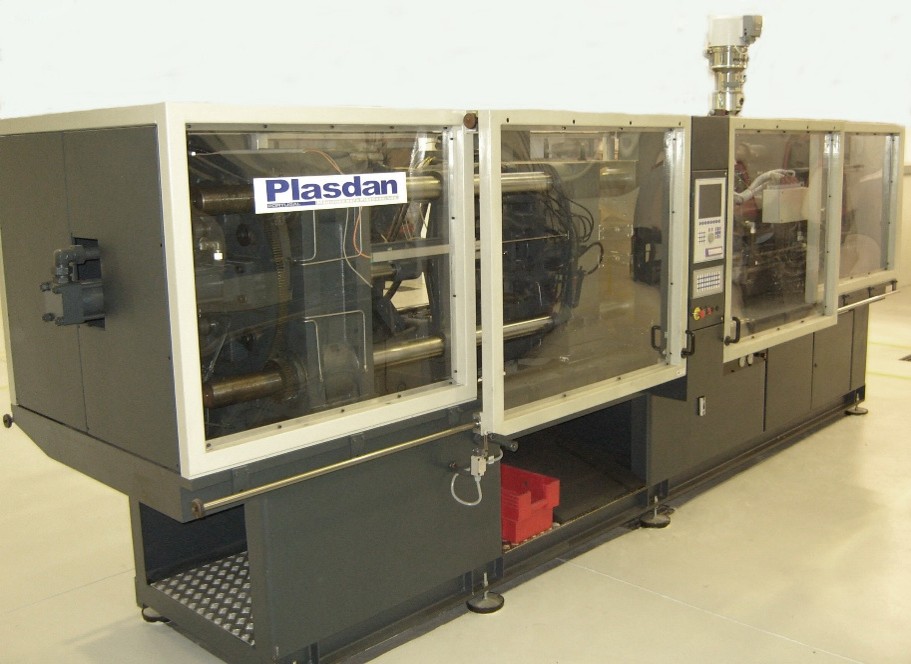
Fig.1 – IMC Unit.
This equipment represents a new paradigm for the plastics sector, as it is estimated to be approximately 40% more energy-efficient compared to the traditional method, which involves extrusion followed by injection molding³.
Additionally, IMC has proven particularly interesting for the recycling of polymers reinforced with synthetic fibres. The recycling of these composites has been the subject of study⁴, and the growing interest in recycling these materials is reflected in their availability and the need to develop effective methods for their reuse. Thermoplastic biocomposites, also called bio-based matrix composites with natural fibres (eco-composites/green composites), are increasingly present in industry. Therefore, they are particularly interesting for the automotive sector, where the use of recyclable or bio-based materials is intensifying⁵. This trend results from the progressive replacement of plastics and synthetic fibres with more natural and/or recyclable alternatives, which brings challenges in terms of processing and final properties of the parts. Thus, given the potential of IMC as a one-step processing methodology, it is possible to improve the mechanical properties of the final product while simultaneously improving its environmental and economic performance. The reduction in energy consumption and the elimination of secondary processing steps make this method particularly advantageous, especially when compared to conventional methods.
Recently, IMC processing variables for raw materials incorporating plant-based fibres and polypropylene-based matrices have been studied, providing insight into the potential of an integrated value chain approach. This study focused on exploring how IMC translates into a more sustainable and economical solution, with particular emphasis on the processing of natural fibres and how processes can become less impactful on circularity.6,7
Currently, and within the scope of Activity 2 of the POLARISE project, PIEP has been exploring this technology as a way to optimise the use of natural resources and reduce waste generated by the processing chain. In this context, activities are underway aimed at developing new formulations that meet market demands. These formulations will be optimised to balance functional, environmental, and economic requirements, ensuring that the final product meets the quality and performance standards demanded by the plastics industry. PIEP has therefore conducted comparative studies between IMC and conventional methods to evaluate the mechanical properties of the processed materials.
In this way, the use of IMC seeks to transform the processing sector, boosting research and development (R&D) as well as productive innovation. With the continuous development of this technology and the increase in research and innovation, it will be possible to further improve the sustainability and quality of the biocomposites produced.

Fig. 2 – Outline of the process.


Catarina I. Faria, Advanced Manufacturing Processes – Polymers R&D Technician at PIEP
Sílvia Cruz, Advanced Manufacturing Processes – Polymers Coordinator at PIEP
Article originally published at Molde Magazine.
[1] ANI (2021). “Portuguese Innovation Agency list of approved projects
[2] Battisti et al. (2013) “Injection-Moulding Compounding of PP Polymer Nanocomposites,” Strojniški Vestn. – J. Mech. Eng., (59/11), 662–668
[3] Bürkle et al. (2009) “Energy-Efficient Processing of Natural Fiber-Reinforced Plastics” Kunststoffe (2), 25–29]
[4] Reciclagem de materiais compósitos de fibra longa por técnica de IMCInjection Moulding Compounder – o potencial das matrizes termoplásticas | PIEP. (2015). Piep.pt. https://www.piep.pt/reciclagem-materiais-compositosimc/
[5] Volvo (2025). Volvocars.com. https://www.volvocars.com/pt/news/
sustainability/future-of-luxury-materials-is-natural-sustainable-andresponsible/
[6] Gusovius et al. (2016) “Processing of wet preserved natural fibers with injection molding compounding (IMC)” RILEM, (12), 197–210
[7] Torres-Giner et al. (2018) “Melt processability, characterization, and antibacterial activity of compression-molded green composite sheets made of poly(3-hydroxybutyrate-co-3-hydroxyvalerate) reinforced with coconut fibers impregnated with oregano essential oil,” Food Packag. Shelf Life (17)

